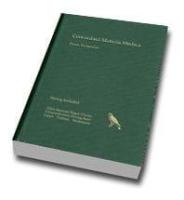
Concordant Materia Medica
- Author
- Frans Vermeulen
- Cover
- Hardback
- ISBN
- 9076189021
- Pages
- 1684
- Printed in
- The Netherlands
- Size
- 155 x 223mm
From the Preface To the Millenium Edition
This Millenium Edition of the Concordant embraces both an extension and a revision of the second English edition. Phatak's additions have been replaced by the original ones, mainly coming from the texts of Hering, Clarke, Kent and Pulford. Yet the general idea behind the Concordant has remained unchanged. What I wrote in 1994 as an introduction therefore still applies:
"This book contains the maximum number of reliable Materia Medica facts in the mini- mum space," Boericke writes in the foreword of his celebrated Materia Medica.
Given the number of good Materia Medicas available, I feel it is time that the maximum number of reliable symptoms was extended, without resulting in an extra metre of book space on every homoeopath's bookshelf.
With this aim - the compilation of a complete but portable Materia Medica - I began by asking myself which authors I should include. The information and the sources they used would have to be reliable and should not be just a duplicate of the work of others.
Experience shows that many Materia Medicas are almost identical, although there is no objection to this as long as they complement each other and provide nuances and complete symptoms.
This is how I arrived at my plan to compare the writings of a large number of authors in order to gain a more complete symptom picture. Completeness is not a question of quantity, of more symptoms per remedy, but of quality, of a detailed examination of each symptom.
Preferably, therefore, with a clear description of localization, sensation, modalities, pains extending and concomitant phenomena. Taken separately, not one of the authors satisfies this criterion, with the exception, of course, of Hering's ten-volume Materia Medica.
If, however, one uses a single basic text - in this case Boericke - and then supplements it with the observations of other authors, thousands of pages of symptoms can be reduced to a handy format, which is the aim of this book.
After painstakingly comparing numerous Materia Medicas to discover which ones complement each other, I arrived at seven which met this requirement. By omitting repetitions, I was able, as it were, to paste the various descriptions together.
Having gone through 3807 pages of text written by the seven authors below, as well as Clarke's Dictionary and Kent's Repertory, I was finally left with the repetition-free symptoms that are contained in the pages of this Concordant Materia Medica.
The authors I decided on are T.F. Allen, Boericke, Boger, Clarke, Cowperthwaite, Lippe, and Pulford. I have used the following Materia Medicas: I include a brief biography of each of the authors I opted for.
Structure of Concordant
The starting point for this book is Boericke's Pocket Manual. His complete text has been used and, where necessary, corrected, since Boericke was not always totally accurate when classifying symptoms in rubrics.
I came across some remarkable - and sometimes amusing - mistakes, such as "Sensitive to odours" included in the Eyes rubric, mental symptoms under Head and problems with stool under Stomach, to mention but a few. I have placed every symptom in the correct rubric, retaining to a great extent the structure of Kent's Repertory.
Where symptoms from the Pocket Manual were too incomplete, and to avoid getting bogged down in a jumble of codes by supplementing those of other authors, I replaced them by the complete symptom as mentioned by another author. Boericke derived his symptoms mainly from the Guiding Symptoms. Besides inaccurate Boericke's Pocket Manual turned out to be so incomplete that revisions were necessary quite often.
Sometimes hiatuses in symptoms given by other authors also made additions or cor- rections necessary. Phatak, for instance, mentions under Lachesis the symptom "Cramps in calves from fear."
This peculiar phenomenon only makes sense when we know the original symptom, as mentioned by Hering: "Cramps in calves from fear of cholera." Since such cramps belong to cholera, the symptom illustrates the power of imagination of Lachesis.
"Tingling pain in shafts of tibia at night when feet are covered," is a symptom given by Cowperthwaite, under Extremities of Rhus toxicodendron. Though apparently quite a peculiar symptom, it proved to be a printing error. In Hering's Guiding Symptoms we can find that the proper modality must be "when feet are crossed."
New Rubrics
By adding the symptoms from both Hering's Condensed and Guiding Symptoms some rubrics grow so huge that they became cluttered. For that reason the number of rubrics has been enlarged in the second edition.
The Eyes rubric has been split up in two separate rubrics called Eyes and Vision. Likewise with the Ears rubric in Ears and Hearing. Preceding the Stomach rubric a new rubric called Food & Drink has been introduced. It contains information about appetite, thirst, smoking, aversions and cravings, as well as the effects of eating and drinking in general and of specific foodstuffs and beverages in particular.
The Mouth rubric is subdivided into Mouth and Teeth. Symptoms related to the gums are placed under Teeth. The Respiratory rubric has been subdivided into three new ones: Respiration, Cough, and Sputum (Expectoration].
The addition of Hering's symptoms threatened to put the Limbs rubric out of joint. It is therefore replaced by a trio: Limbs [in general], Upper [limbs] and Lower [limbs]. The Lower [limbs] rubric usually exceeds the Upper [limbs] rubric in size.
Wherever this is not the case - like in Crotalus horridus, Lobelia, Sanguinaria, Stannum, Ustilago and Viola odorata - it offers interesting clues. The Sleep rubric is followed by a new rubric called Dreams.
In the old books the words Fever and Heat seem to be interchangeable. However, in the strict sense of the word they must be differentiated.
Fever includes the mixture or succession of three stages: heat (hot stage], chill [cold stage] and perspiration (sweating stage]. Information about all three stages, or about fever in general, I have placed in the rubric Fever.
The Chill rubric contains the cold stage as such (Chill] and the sensitiveness to cold [Chilliness]. The Heat rubric covers the hot stage of fever, and warmbloodedness in general. The circumstances and modalities of perspiration are placed in the Sweat rubric.
Symptoms related to the heart and circulation are in a separate rubric, called Heart; these symptoms are in the Chest rubric in Kent's Repertory. I have not placed symptoms related to the prostate gland in the Urinary rubric; instead, I have classified them under the male sexual organs [Male].
The head to toe classification is used throughout, preceded by a rubric which, in Boericke, directly follows the name of the remedy and, in Allen, Cowperthwaite etc., has the header "Generalities".
I have amalgamated these two rubrics into a rubric I call "Characteristics", which contains the generalities and the typical [general or local] symptoms of a remedy.
About the author:
Frans Vermeulen was born in July, 1948 in Den Helder, Holland. He graduated from teachers training college in 1970. He worked as a schoolteacher until 1978 and had already started to study homeopathy at Stichting Klassieke Homeopathie in Den Haag. He continued to study homeopathy until 1983 although he had been running his practice since 1979.
Frans started to translate homeopathic books for work and pleasure. Between 1983 and 1996 he translated English and German homeopathic books, including Kent, Allen, Hering, Boericke, Borland, Tyler, Vithoulkas, Voegeli, Whitmont, Miles, Morgan and Kohler.
In 1985 he wrote Kindertypes in Homoeopathie (Children's Types in Homoeopathy), based on his experiences as both a teacher and a homoeopath.
In 1990 he was appointed managing director, teacher, and administrator of The School of Homeopathy in Holland. In 1992 he wrote Synoptic Materia Medica 1 which originally emerged from remedy summaries made for the students in Holland, Ireland and Finland.
He followed this one up with the Concordant Materia Medica published in 1994. Followed by a second edition of the Concordant, including Hering's Guiding Symptoms in 1997; a third edition was printed in 2000.
Out of his special interest in the small remedies, Frans wrote Synoptic Materia Medica 2. In his recent Materia Medica tour de force entitled PRISMA, he introduces us to data from numerous non-homoeopathic sources as both reference material for the homoeopathic materia medica and as the source of potential symptoms. The significance and potential of such external data has been the subject of his numerous seminars in Europe, Israel and Australia.
And finally, in 2005, Frans published an astounding 800 page book focused on the Materia Medica of bacteria and viruses, entitled Monera. He followed it early in 2007 with volume 2, another heroic work of scholarship on Fungi.
Deliveries
Packing & delivery is calculated automatically to give the most economical delivery method. We work closely with our postage partners to try and ensure you always get the best price. We do not mark-up out post & packing rates.
Estimated delivery times
If you need your order quickly please contact us and we will always do our best to get it to you as fast as possible.
UK
Estimated delivery time for a UK order is 3 - 4 working days.
North America
Estimated delivery time for an order to North America is 7 - 14 working days.
Europe
Estimated delivery time for an order to Europe is 4 - 10 working days by normal post.
Far East, Australia & New Zealand
Estimated delivery time for an order to the Far East, Australia & New Zealand is 10 - 21 working days.
South America
Estimated delivery time for an order to South America is 10 - 21 working days.
Middle East & Africa
Estimated delivery time for an order to the Middle East & Africa is 10 - 21 working days.
Returns & Cancellation
Thank you for ordering with The School of Health and/or the School of Homeopathy. We hope you love your course and products as much as we do, and that you are entirely satisfied with your purchase. Should you need to cancel or return any items to us please carefully follow the guidelines below.
Refund & returns policy
We offer a 14-day money back guarantee on most items purchased from us (in line with UK & EU regulation), and the possibility of a 3-month partial refund policy on home study courses, based on an assessment.
Within 14 days: refund for Home Study Courses excluding Registration fee and P&P costs – and excluding digital goods and services.
We can accept return of unwanted items and cancellation of home study courses, in line with our refund policy, provided you have not accessed or downloaded any content from the Online Learning System and the goods are completely unused and returned to us in perfect condition. The return costs are covered by you and any items lost in the post are your liability.
Please contact us in the first instance, in writing, within 14 days after receiving the goods. You must await our response and returns form, and then you have 14 days to return the goods, following these steps:
Digital goods and services
Please be aware that, as soon as you download, access or stream content from the Online Learning System, you will lose your right to the 14-day right to cancel the course and any refund. Due to the nature of digital goods, and in line with UK & EU legislation, we do not accept returns for: Memory Sticks, CDs, DVDs and Data discs.
What to do:
STEP 1: Start off by sending us an email or letter within 14 days of receiving the items stating your wish to cancel your order and we will send you a Cancellation Form. Please do not send anything back without first hearing from us and receiving our Returns Cancellation Form.
STEP 2: Materials need to be returned within 14 days from receiving the Returns Cancellation Form. All returned items must be received by us in perfect condition with the packaging un-opened and the goods unused. This will probably require you to add new/extra packaging and you will need to cover the costs of returning the goods. Please use a recorded delivery service, as we cannot be held responsible for non-delivery of returned items.
STEP 3: We will refund the price of the goods once they have been received and checked and the amount relates to the fees applied at the time of purchase. Course registration fees and delivery costs are non-refundable. The refund will be made as soon as reasonably possible and within 30 days from the day you cancelled in writing.
Within 3 months: partial refund (for home study courses only)
Beyond the 14-day period, if you wish to withdraw from your course for good reason, a partial refund may possibly be granted if you purchased the course with tutor marking, are still inside the three-month period and have not accessed the online learning system or submitted the starter assignment or work to your tutor for marking. Please bear in mind that this is not a given statutory right and we offer this possibility in the spirit of good will. In the first instance, we will do all we can to understand your problem and offer help to see if there is a good way forward - we find a lot can be gained through having this conversation. If all the above criteria have been met and we agree that you have good reason to withdraw, a partial refund for the tutor marking element of the course may be granted. The tutor marking amount equates to 40% of the course fee excluding registration and post and packing costs.
What to do:
STEP 1: Start off by sending us an email or letter within 3 months of receiving the course, stating your wish to withdraw from the course and giving your reasons. Please do NOT send anything back to us, as we cannot accept returned materials after the 14 day cooling-off period.
STEP 2: The Course Manager will then contact you to discuss the issues you have raised and together you will see if you can find a good way forwards. Quite often, a new student will have worries or problems that can be helped with some care and attention and our team are here to do all they can to support and assist in helping you to get settled in and off to a good start. You are never alone!
STEP 3: If both parties agree that there is no resolution to the issues raised, then we will advise if a partial refund may be granted. The maximum amount that can be refunded is 40% of the course fee excluding the non-refundable registration fee and delivery costs. The Course Manager will advise about this.
Refunds - Attendance course
Places are limited on the Attendance Course and, when you enrol, you are making a commitment to pay the annual fees in full. This commitment applies whether you are paying in full beforehand or by monthly instalments. Fees must be paid up in full before the end of the academic year in order to move into the next year of study. A refund will only be considered in the case of certain unforeseeable circumstances, such as bereavement, pregnancy and moving overseas, and at the discretion of the directors. Registration fees and deposit are non-refundable. Anyone who chooses to leave midway through the year will be required to pay the outstanding balance of the annual fee when they leave, and will be required to re-join that year group upon return to the School.
Refunds - Events
- 4 or more weeks notice – We can give a 50% refund or reschedule.
- 2-4 weeks notice – We can give a 25% refund or maybe reschedule.
- Less than 2 weeks – There is no refund offered with no obligation to reschedule your course date.
You can reschedule once, and only to a course that takes place within 12 months of your original booking. Rescheduling an event will incur a £15 admin fee. Registration fees and deposits are non-refundable or transferable.
Cancellation of an Event
Occasionally there may be insufficient numbers of students to allow a training day to proceed, and if this happens the following procedure will take place:
1. Notice will be given by email and a telephone call at least 5 days before the course start date.
2. Students will be given the opportunity to reschedule their course to another date. You can only reschedule once and only to a course that takes place within 12 months of your original booking.
3. If there is no convenient date for rescheduling then students will be fully reimbursed.
4. We cannot compensate for any travel or accommodation costs incurred. Always get insurance for your travel.
Travel & accommodation
If you are planning to travel or stay locally, we kindly ask that you make your own arrangements with flexibility in mind. While we very much hope all events run as planned, occasionally dates may need to change or, in rare cases (such as low booking numbers or unforeseen circumstances), an event may need to be postponed or cancelled. For this reason, we recommend booking flexible options where possible and taking out appropriate travel insurance. Please note that we are unable to accept liability for travel or accommodation costs incurred, including in the event of changes to event dates or cancellation.
Faulty Items
Should you receive any items that are damaged, please write or email us within 14 days and we will advise about how to proceed. Please provide as much information as possible when contacting us, including your order number, email and a daytime contact number in case we should need to call you.
Contact us
Email: info@soh.uk
Phone: + 44 (0)1453 709 709
Admin Office: Orchard Leigh, Rodborough Hill, Stroud, Gloucestershire, Stroud, GL5 3SS
Any questions
If you need help with anything at all, please contact us and one of the team will be happy to assist.
Thank you
https://www.gov.uk/accepting-returns-and-giving-refunds
https://www.gov.uk/online-and-distance-selling-for-businesses